





 1 min read
 1 Views



What Is Agile Development? A Beginner’s Guide
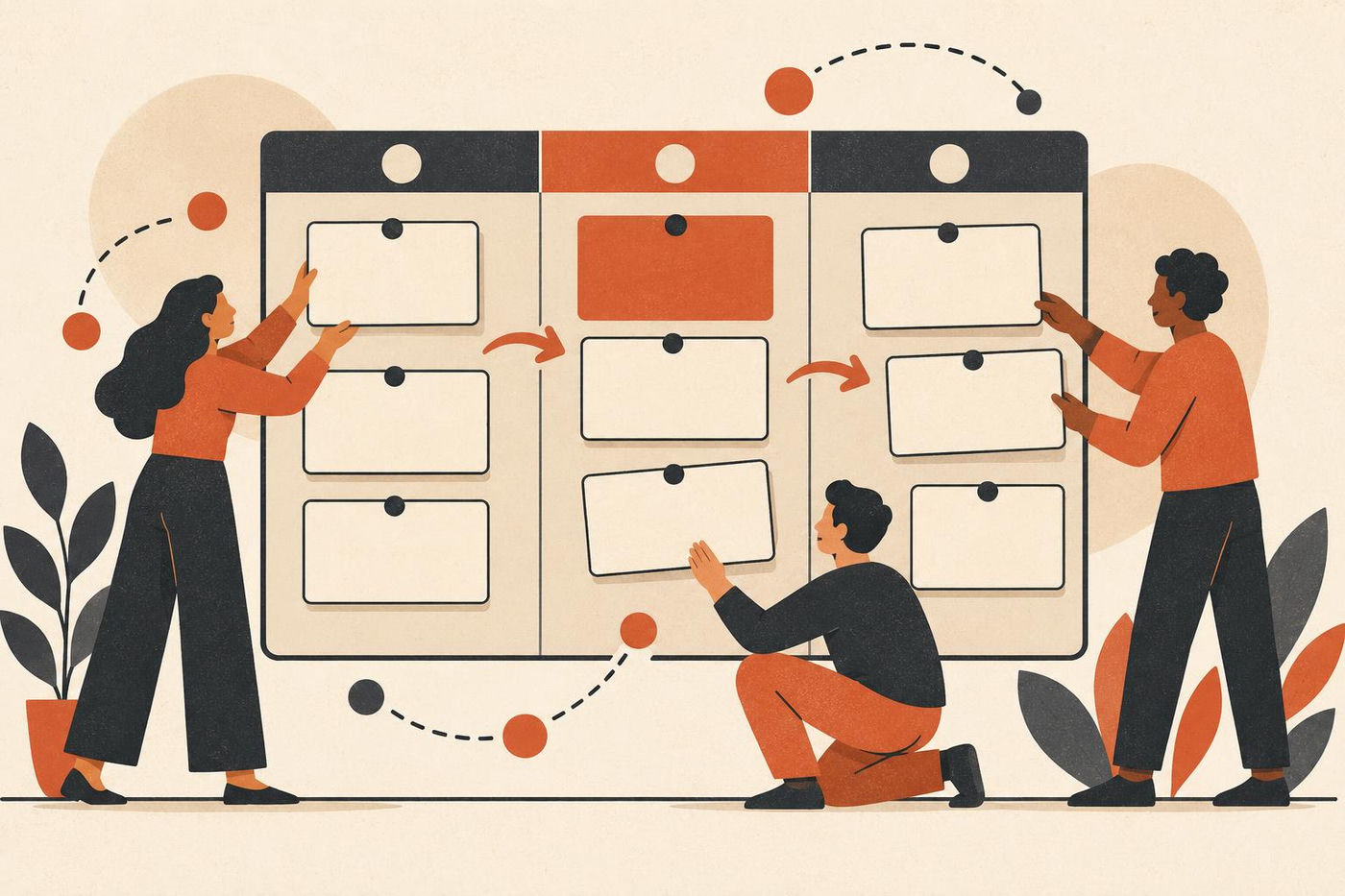
To define agile development simply: it is an iterative way to build software, deliver useful pieces early, and adapt the plan as teams learn from feedback. Instead of treating a long specification as untouchable, Agile makes working software, collaboration, and regular improvement central to the process.
That definition matters in practice. A game team may discover that a new gameplay system creates a Rust borrowing conflict; a web team may find that its API shape makes a Svelte interface awkward to use. Agile gives teams a repeatable way to surface those problems early, make a small change, and check whether the result works. At UniqTech, that approach supports mobile and web apps, high-end games, and high-performance software built with Rust and Svelte.
What does agile development mean exactly?
Agile development is a software delivery approach in which a team works in short cycles, shows progress frequently, and uses feedback to adjust what it builds next. A cycle is often called an iteration or sprint. Scrum commonly uses time-boxed sprints of one to four weeks; that is a framework convention, not a rule that every Agile team must follow.
Agile is not a synonym for “no plan.” A team still sets goals, makes technical decisions, tests its work, and tracks risks. The difference is that planning happens at more than one horizon: the team keeps a broad direction while refining near-term work as evidence arrives. For a more detailed look at the practices behind it, see this guide to Agile methods and how teams use them.
Why ownership bugs make a useful Agile example
Agile becomes tangible when a team catches a costly-looking problem while it is still small. Consider a Bevy game migration: while reorganizing a gameplay system, a developer tries to mutate an entity’s health and also read its transform through the same mutable query borrow. The precise API details can vary with the Bevy version and project setup, so treat this as a representative migration-time conflict—not a claim that a particular Bevy 0.20 release introduced this exact error.
fn update_health(
    mut query: Query<(&mut Health, &Transform)>,
) {
    for (mut health, transform) in &mut query {
        health.current -= damage_from_position(transform);
    }
}
This compact example may compile if the query’s component access is valid and the function only reads the transform. The conflict appears when migration work changes the code to acquire a second overlapping mutable access to the same entity—or when separate system parameters request incompatible access to the same component data. For example, two mutable queries over the same component set can trigger Bevy’s system-access validation. The right fix is not to suppress the warning: make access disjoint, combine the work in one query, or redesign the system boundary.
Use a reverse mental model to diagnose it: start with the resource or component being borrowed, then trace backward through every query, system parameter, and helper that can access it. Ask, “Who can write this data while another path reads or writes it?” That is more productive than starting from the compiler message and changing random lines. A small review-and-test cycle can settle the design before the conflict spreads into more systems. For migration context, explore the Bevy 0.20 development notes; teams interested in game work can also see UniqTech’s software development portfolio.
Where the Rust-to-Svelte boundary needs iteration
Ownership is not only a game-development concern. In a Rust service that supplies data to a Svelte interface, the boundary is usually a serialized message: JSON, for example. A Rust type may represent an optional value, an enum, or a timestamp in a way that does not naturally match the UI’s assumptions. If the frontend needs a stable, display-ready shape, discovering that mismatch during an integration demo is much cheaper than discovering it after several screens depend on an unclear contract.
A practical cycle is to agree on one representative response, serialize it, and render it in a small Svelte component before expanding the feature. Check nullability, enum values, field names, and error states. Then revise the contract while the change is still contained. This is not a reason to duplicate business logic in the browser; it is a reason to make the interface between systems explicit. UniqTech’s article on Rust serialization design covers the boundary in more depth. For larger systems, a gradual modernization strategy such as the Strangler Fig pattern can also help teams replace parts incrementally rather than attempting a risky all-at-once rewrite.
How Agile teams review AI-generated code
AI-assisted development can produce a useful first draft quickly, but generated code still needs engineering judgment. Imagine an AI-generated Rust binding intended to expose an application state update to Svelte. The code creates a mutable borrow of state, then calls a helper that also needs mutable access to the same state. A review step can flag the likely borrow conflict before the binding is integrated:
// Illustrative generated-code shape
let state = app.state_mut();
state.update(build_payload(state.current_user()));
Depending on the actual types and evaluation details, this shape may fail to compile because the mutable borrow overlaps with an access needed to build the payload. The safer pattern is to gather the read-only input first, then perform the mutation:
let user = app.state().current_user().clone();
let payload = build_payload(user);
app.state_mut().update(payload);
A human should still verify that cloning is appropriate and that the real API has the assumed methods; a snippet is not a substitute for compiling and testing the project. The useful workflow is to let AI accelerate a draft, have ownership analysis and code review identify risky access patterns, then validate with the compiler and focused tests. This is one practical application of AI-augmented engineering, not an assurance that generated code is automatically safe. UniqTech also discusses agentic AI development and AI-accelerated software delivery.
How does agile development benefit software teams?
The benefit is not “more meetings.” It is a tighter feedback loop between a decision and evidence about that decision. A team can validate a user flow, performance assumption, or technical boundary before investing heavily in the wrong approach. A reviewable increment also gives stakeholders something concrete to respond to, rather than asking them to imagine a finished product from a specification.
- Earlier risk discovery: compile errors, integration gaps, and confusing user journeys appear while changes are still relatively local.
- Visible progress: regular demonstrations show what works and what remains uncertain.
- Better prioritization: teams can revisit the backlog when user feedback or technical evidence changes the value of a feature.
- Continuous quality: testing, code review, and refactoring can happen throughout delivery instead of being postponed to a final cleanup phase.
Agile does not guarantee that a project will be faster or cheaper. Poorly defined goals, oversized work items, and unaddressed technical debt can undermine any process. The practice is to make progress inspectable and respond deliberately. The Agile software development methodology guide offers another view of how teams structure that work.
Agile versus a plan-driven approach
| Question | Agile approach | Plan-driven approach |
|---|---|---|
| When is work reviewed? | Frequently, in small increments | Often at specified project phases |
| How does scope respond to learning? | Near-term priorities can be revisited | Changes are commonly managed through formal change control |
| What is the main strength? | Adapting through frequent feedback | Predictable sequencing where requirements are stable |
| What is a common risk? | Uncontrolled scope changes without clear priorities | Late discovery that assumptions or requirements were wrong |
Neither column is automatically superior. Regulated work, fixed procurement constraints, or hardware dependencies may require substantial upfront planning. Even then, teams can use iterative prototypes and regular reviews where appropriate. For a product with evolving user needs, short feedback cycles can be especially useful. Related reading includes adaptive software development and Agile software delivery in practice.
Is agile development suitable for every project?
Agile can help many software projects, but it is not a universal prescription. It works best when a team can obtain feedback, inspect working increments, and make decisions as it learns. If requirements are genuinely fixed, external approvals are slow, or a physical dependency prevents frequent releases, the team may need longer planning windows or a hybrid process. The core idea still applies: identify assumptions, manage risks explicitly, and validate what can be validated early.
For beginners, a useful starting point is simple: agree on a small outcome, define what “done” means, build and test it, show it to the people who can give feedback, and use what you learn to choose the next step. That is the practical meaning behind define agile development: not following a ceremony for its own sake, but organizing delivery so the team can learn and adapt while producing working software.
Have a product idea or a technical challenge that needs a thoughtful delivery plan? Explore how UniqTech can help with mobile and web apps, high-end games, Rust and Svelte software, or AI-accelerated development.